
NFL Player Prop Betting Analysis and Market Data
 Available in US
I placed my first NFL player prop bet in 2018 — a passing yards over on a Thursday night game that hit with room to spare. Eight years later, that single market has exploded into the fastest-growing segment in sports betting, and the UK has become one of the sharpest audiences for it. The numbers tell the story better than I can. The UK gambling industry generated £12.6 billion in gross gaming yield in the year to March 2025, with 13.5 million active online accounts placing bets every month. Within that ecosystem, proposition bets — wagers on individual player performance rather than match outcomes — have grown by more than 60% year on year across major leagues, with bookmakers now routinely publishing five or more prop lines per starting player in every NFL game.
£12.6bn
UK gambling industry gross gaming yield, April 2024 — March 2025
60%+
Year-on-year growth in prop bet volume across leading leagues
13.5M
Active online betting accounts in the UK per month
This guide is built for UK punters who want more than a list of welcome bonuses and a vague nudge to "do your research." I have spent eight years specialising in NFL player props — analysing matchups, tracking line movement, and stress-testing strategies against real data. What follows is everything I wish someone had handed me when I first opened a prop market on a Sunday evening in London: the mechanics, the maths, the market context, and the tactical frameworks that separate informed bettors from everyone else scrolling through a bet builder at kickoff.
Whether you are placing your first passing yards over/under or refining a system you have run for three seasons, the structure here moves from fundamentals through to strategy, regulation and responsible bankroll habits. Every claim is anchored to a number or a source. No affiliate rankings. No "sign up now" buttons. Just the analysis.
Core Betting Framework – The Five Pillars of NFL Props
- NFL player props are wagers on individual performance — passing yards, rushing yards, touchdowns, receptions — independent of match results, and they have grown over 60% year on year across major leagues.
- The UK betting market generated £12.6 billion in GGY (2024-25), with 13.5 million active online accounts monthly — NFL prop markets are a growing share of that activity.
- Five prop categories dominate: passing, rushing, receiving, defensive, and touchdown scorer. Each requires different data inputs and analytical frameworks.
- Strategy beats instinct: matchup analysis, game script prediction, cross-book line shopping, and expected value thinking are the methods that produce long-term edge.
- UKGC licensing is non-negotiable. New regulations from 2025-2026 — mandatory financial limits, increased operator tax rates — directly affect how and where you bet on NFL player props in Britain.
What Are NFL Player Props and Why UK Punters Are Betting Them
Three years ago, a mate who had been betting football accumulators for a decade asked me what a "prop" was. He had seen the tab on his bookmaker app but never opened it. Today he bets almost nothing else. That trajectory — from curiosity to conversion — is happening across the UK betting market at a pace that even the bookmakers did not fully anticipate.
A player prop bet (short for proposition bet) is a wager on an individual player's statistical performance within a game, independent of the match result. You are not betting on which team wins. You are betting on whether a specific quarterback throws over or under 274.5 passing yards, whether a running back exceeds 62.5 rushing yards, or whether a wide receiver scores a touchdown at any point during the game.
The appeal is intuitive once you grasp it. Traditional match betting — moneyline, point spread, game totals — forces you to predict the behaviour of 22 players, two coaching staffs, and a referee crew operating as a single unit. A player prop narrows the lens to one individual. You are not asking "will the Chiefs beat the Bills?" You are asking "will Patrick Mahomes throw for more than 265.5 yards against a secondary that ranks 28th against the pass?" That is a fundamentally different analytical exercise, and it rewards a different kind of research.
Over/under — a bet type where the bookmaker sets a statistical line (e.g. 274.5 passing yards) and you wager on whether the actual result will finish above (over) or below (under) that number.
Proposition bet — any wager that is not directly tied to the final score or outcome of a game. Player props are the most common subcategory, focusing on individual statistical outputs.
The growth has been staggering. Prop bets have expanded by more than 60% year on year across leading sports leagues, and the NFL sits at the centre of that expansion. Bookmakers now routinely offer five-plus prop lines per starting player per game — passing yards, rushing yards, receptions, touchdowns, interceptions, and increasingly niche markets like longest completion or first reception. For UK punters, the timing aligns perfectly with the evening kickoff schedule: the first Sunday games start at 18:00 GMT, giving you a full afternoon to review injury reports, check weather data, and finalise your selections before a single snap is played.
Bill Miller, President and CEO of the American Gaming Association, framed the broader trend this way: legal sports betting enhances the competition that makes NFL games special, and with strong consumer protections, the regulated industry encourages fans to have a plan before placing a bet. That principle applies doubly to player props, where a plan means something concrete — a statistical thesis, not a gut feeling.
Passing yards over/under — example
Suppose a quarterback's passing yards line is set at 274.5. The bookmaker prices the over at 1.91 (decimal) and the under at 1.91. If you stake £10 on the over and the quarterback finishes with 289 passing yards, your return is £19.10 (£10 x 1.91), giving you a profit of £9.10. If he finishes with 261 yards, you lose your £10 stake.
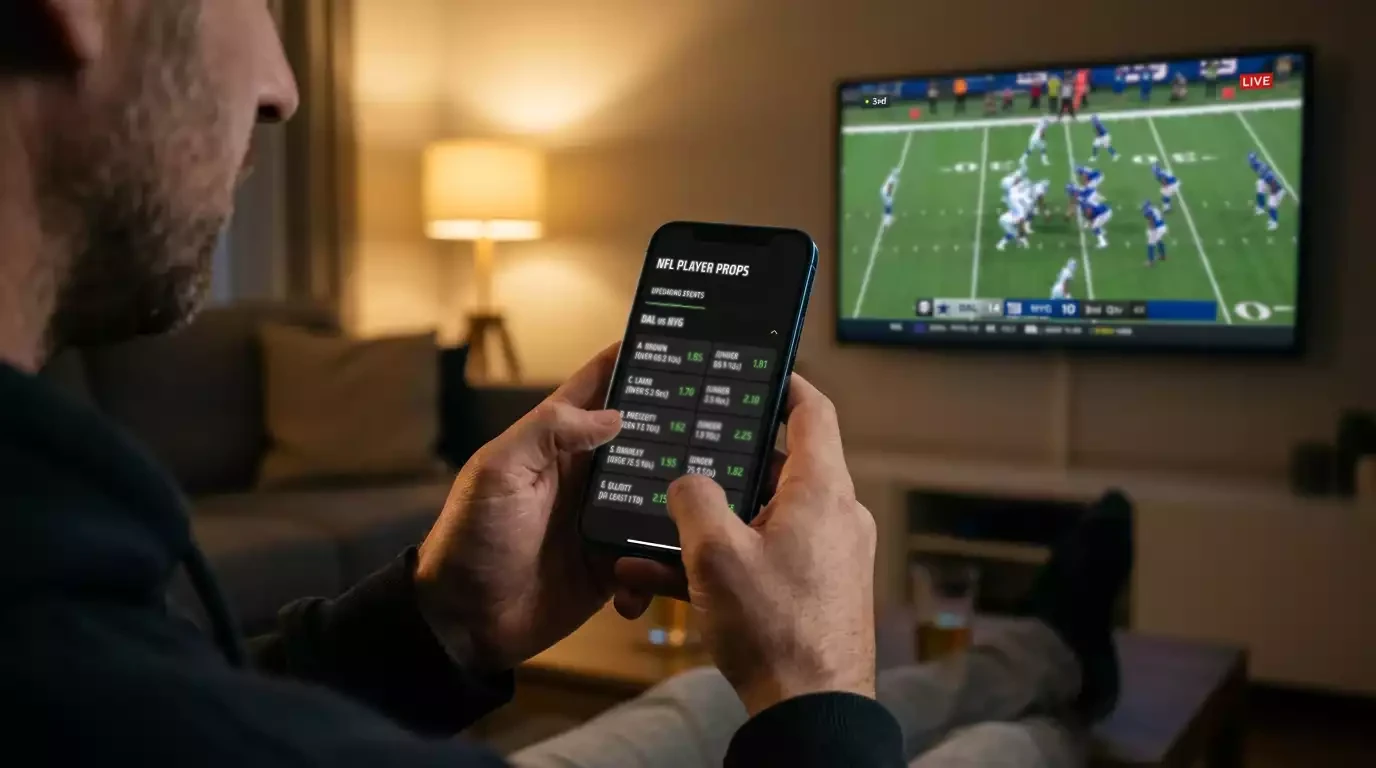
The reason UK punters are gravitating toward props rather than traditional match markets comes down to perceived control. In a moneyline bet, a last-second field goal can flip your result. In a passing yards prop, you are tracking accumulation across four quarters — the variance is still there, but the analytical surface area is wider, and the data inputs are more granular. For a deeper breakdown of every prop market type, from completions to combo props, I have written a full guide to NFL player props explained with payout calculations and odds format walkthroughs.
Types of NFL Player Props Available to UK Bettors
When I first started tracking NFL props in the UK market, you were lucky to find passing yards and anytime touchdown scorer on a Sunday afternoon. Walk into that same bookmaker app today and the menu reads like a statistical buffet. UK punters placing an estimated 290 million online bets per month across all sports now have access to prop categories that rival anything available in Las Vegas — and in some cases exceed it, thanks to the competitive pressure between UKGC-licensed operators to offer deeper markets.
The five core categories below cover the vast majority of what you will encounter. Each operates on its own logic, its own data inputs, and its own risk profile.
Passing props
Yards, touchdowns, completions, attempts, interceptions, longest completion. The quarterback-driven market and typically the deepest.
Rushing props
Yards, carries, longest rush, rushing touchdowns. Driven by running back workload and game script.
Receiving props
Yards, receptions, targets, longest reception. Wide receivers and tight ends — target share is king.
Defensive props
Sacks, interceptions, tackles, forced fumbles. The thinnest market but often the most mispriced.
Touchdown scorer
Anytime, first, last. Any player who reaches the end zone. Red zone usage data is the primary analytical input.
Passing props — wagers tied to a quarterback's throwing statistics: yards gained through the air, completed passes, touchdown passes thrown, and interceptions.
Rushing props — wagers on a player's ground-game output, primarily rushing yards and carries, most commonly associated with running backs but also applicable to mobile quarterbacks.
Receiving props — wagers on pass-catching statistics: receiving yards, total receptions, and targets. Applied to wide receivers, tight ends, and occasionally running backs.
Defensive props — wagers on individual defensive statistics such as sacks, interceptions, tackles, and forced fumbles. These markets are less common and often carry wider margins.
Touchdown scorer — a wager on whether a named player will score a touchdown during the game. "Anytime" means at least one; "first" and "last" specify the sequence.
Passing Yards and Touchdown Props
Passing props are the flagship market. Every NFL game starts with a quarterback, and every quarterback generates data — completions, attempts, yards, touchdowns, interceptions. The most liquid line is passing yards over/under, which typically lands somewhere between 220 and 310 depending on the matchup, weather, and the quarterback's season average. Touchdown passes are priced as over/under (usually 1.5 or 2.5) or as exact totals, and interception props often carry attractive odds because turnovers are inherently volatile events.
Passing touchdown over/under — example
A quarterback's passing touchdown line is set at 1.5. The over is priced at 1.72 and the under at 2.10. If you believe the matchup favours multiple scoring drives, a £10 bet on the over returns £17.20 when the quarterback throws two or more touchdowns. The under pays better per unit because it is statistically more likely in low-total games.
What makes passing props analytically rich is the number of variables you can isolate. Opponent pass defence ranking, blitz rate, secondary injuries, indoor versus outdoor venue, wind speed — each factor shifts the distribution of likely outcomes. I have found that passing yards is the market where the most consistent edge exists for prepared bettors, precisely because the data inputs are so well-documented and publicly available.
Rushing Yards and Carry Props
Rushing props live and die by volume. A running back who receives 20 carries has a fundamentally different probability distribution from one who splits the backfield with two other players and touches the ball eight times. The over/under on rushing yards is the primary market, but carry props (total rushing attempts) can be equally valuable because they strip out the per-carry variance and focus purely on workload.
Game script is the invisible hand here. A team expected to lead by two touchdowns in the second half will lean on the run game to burn clock, inflating rushing volume for their lead back. A team trailing by 14 at halftime abandons the run almost entirely. Understanding that dynamic before kickoff — by reading the point spread and game total — gives you an informational advantage over bettors who look only at the player's season average.
Receiving Yards, Receptions and Target Props
Receiving markets are where I see UK bettors making the fastest gains in sophistication. Target share — the percentage of a team's total pass attempts directed at a specific receiver — is the single most predictive metric for receiving props, and it has become freely accessible through multiple online databases. A wide receiver commanding a 28% target share on a team that throws 35 times per game has a stable baseline that adjusts predictably when you account for the opposing cornerback's coverage grade.
Receptions (catches) props tend to have tighter lines than yardage because a high-volume short-pass offence can generate eight receptions for only 55 yards. Knowing the receiver's average depth of target tells you whether a high catch count correlates with high yardage or not — and that distinction is where mispriced lines hide.
Anytime and First Touchdown Scorer
Touchdown scorer props are the most popular entry point for casual bettors, and for good reason — they are conceptually simple and carry enough variance to produce exciting odds. Anytime touchdown scorer means your selected player needs to find the end zone at least once during the game. First touchdown scorer carries significantly higher odds because you are predicting not just that a touchdown occurs but that it happens on the first scoring play.
Anytime TD scorer — example
A running back is priced at 1.80 to score anytime. You stake £10. If he punches in a one-yard rushing touchdown in the third quarter, your return is £18.00. A first TD scorer price for the same player might sit at 9.00 or higher, reflecting the much lower probability of being the game's opening scorer.
Red zone usage is the critical data point. A player who sees 30% of his team's red zone targets has a structurally higher probability of scoring than one who sees 12%, regardless of their overall yardage numbers. I always cross-reference red zone target share with the opposing defence's red zone touchdown rate allowed before pricing a touchdown prop in my head.
The UK Betting Market: Where NFL Fits in a £12.6 Billion Industry
I remember sitting in a pub in Shoreditch during the 2019 London Games, watching a group of twenty-somethings with half-empty pints screaming about a fourth-quarter interception — and then immediately pulling out their phones to place live bets. That scene would have been unthinkable a decade earlier. NFL betting in the UK is no longer a fringe activity bolted onto the football coupon. It is a structurally significant and rapidly growing segment within the largest regulated gambling market in Europe.
£12.6bn
GB gambling GGY excluding lotteries, April 2024 — March 2025, up 9.3% year on year
290M
Online bets placed on real-event sports every month in the UK
10%
Share of the British population participating in online sports betting
The headline number — £15.6 billion in total industry GGY for the year to March 2024, rising to £12.6 billion excluding lotteries for the year to March 2025 — barely hints at the structural shift underneath. Andrew Rhodes, Chief Executive of the UK Gambling Commission, put it bluntly: gambling in Great Britain has reached the highest GGY the regulator has ever recorded. The remote sector — online casino, betting, and bingo — generated £7.8 billion of that total, growing 13.1% year on year, which tells you exactly where the momentum sits. It is not in the high street. It is on your phone, at 18:00 on a Sunday, with an NFL player prop market open.
The remote casino, betting, and bingo sector grew 13.1% year on year to £7.8 billion in GGY for the year ending March 2025 — nearly double the growth rate of the overall market.
Online sports betting on real events specifically accounted for £2.6 billion in GGY during 2024-25, with football (soccer) claiming roughly half of that at £1.3 billion. American football does not command its own GGY line in the Commission's data, but the directional indicators are clear: NFL viewership in the UK is climbing, London Games attendance is consistently at maximum capacity, and bookmakers are expanding their NFL prop offerings season on season. Fifteen percent of men and four percent of women in Britain bet on sport, and 10% of the total population engages with online sports betting — a customer base of millions that NFL prop markets are increasingly designed to serve.
NFL Fandom in Britain: From Wembley Sellouts to Nightly Sky Sports
The numbers that underpin NFL prop betting demand start with eyeballs. The UK accounts for approximately 3% of global NFL search traffic — a figure that sounds modest until you realise it places Britain ahead of Germany and every other non-North American market. That search volume translates directly into betting activity, because the journey from "NFL highlights" to "player prop markets" has become a two-tap process on any major UK bookmaker app.
The most popular NFL team in the UK is the Kansas City Chiefs, commanding 9.5% of search interest — roughly 50,000 queries per month. That dethrones the long-assumed leader, the Miami Dolphins, and reflects the Patrick Mahomes effect on British fandom. The Philadelphia Eagles and San Francisco 49ers sit joint second at 6.3% each.
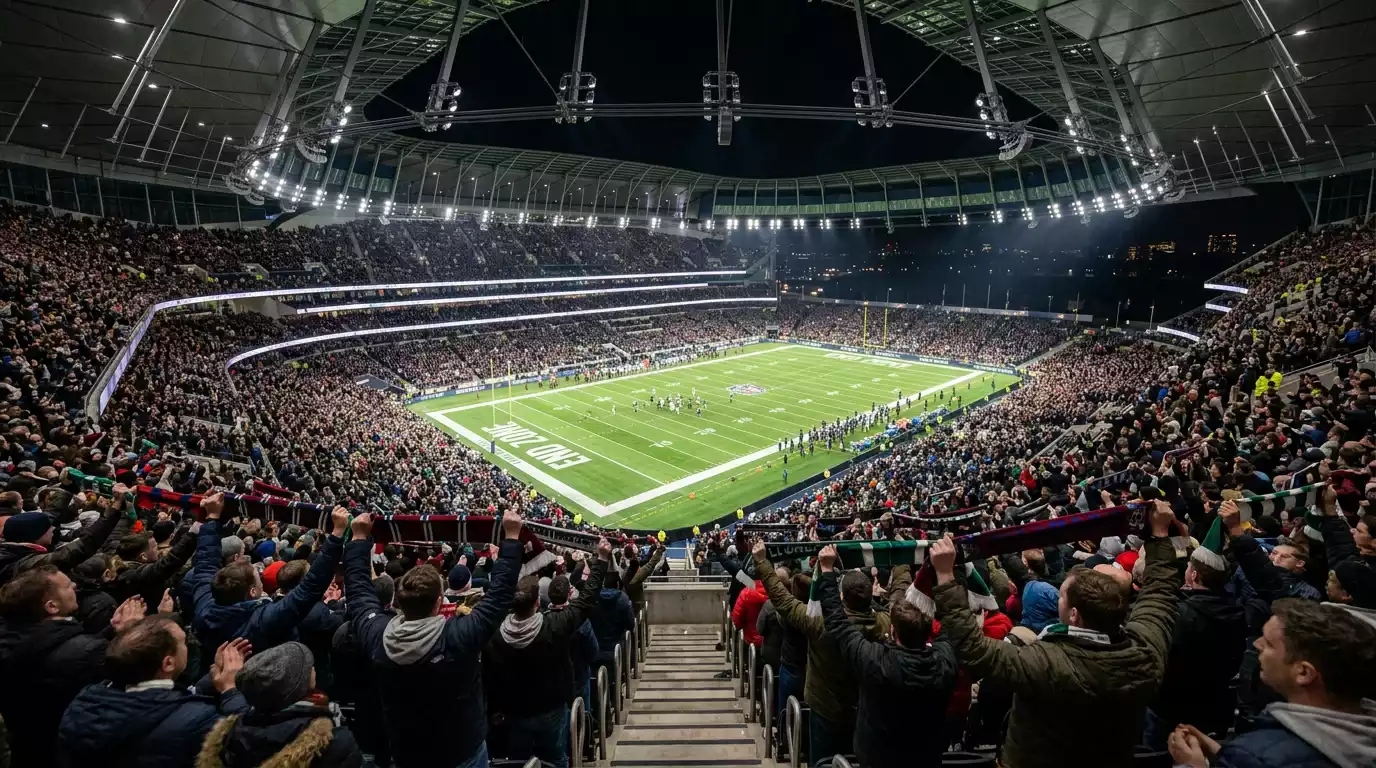
The demographic skew matters for prop betting specifically. Sixty-eight percent of NFL fans in the UK fall within the 18-44 age bracket — a cohort that over-indexes on mobile betting, same-game parlays, and player-specific markets compared to older demographics who lean toward traditional match outcomes. When the NFL stages games at Wembley (capacity roughly 86,000) and Tottenham Hotspur Stadium (around 61,000), both venues sell to maximum capacity. Thirty-nine London games since 2007 have built a layer of cultural familiarity that turns casual viewers into engaged bettors.
Jamie Reynolds, a UK-based sports marketing consultant, captured the dynamic well: British fans are less tribal than American ones — a team's global profile, its appearances on Sky, and those first Wembley or Tottenham experiences often stick with fans for life. That less tribal, more analytical mindset is precisely what makes British NFL fans natural candidates for prop betting. They are not locked into supporting one team; they are watching matchups, comparing players, and looking for statistical edges across the entire slate.
How to Place an NFL Player Prop Bet: Step-by-Step for UK Punters
Every season I get messages from people who have watched NFL for years but freeze the moment they open a prop market for the first time. The interface looks different from a football coupon. The numbers have decimal points. The terminology feels borrowed from another country — because it is. So here is the process, stripped back to what actually happens between deciding you like a matchup and seeing the bet confirmed on your slip.
Placing a passing yards over bet — walkthrough
Step 1: Open your bookmaker app and navigate to American Football, then select the specific NFL game you have analysed.
Step 2: Find the "Player Props" or "Player Markets" tab within that game. This is separate from the match markets (moneyline, spread, totals).
Step 3: Select the market category — in this case, "Passing Yards." You will see the quarterback's name and a line, say 269.5.
Step 4: Choose Over or Under. Suppose you have determined that the opposing pass defence ranks in the bottom five and the game total is set high at 49.5 — you tap Over 269.5.
Step 5: The selection appears on your bet slip with decimal odds, say 1.91. Enter your stake — £10. The potential return displays automatically: £19.10.
Step 6: Confirm the bet. Your bookmaker locks the odds at the moment of placement (unless you have opted into price movement acceptance).
The critical decision point in that sequence is Step 4 — choosing the side. Everything before it is navigation; everything after it is execution. The analysis that informs that choice is where this guide earns its keep, and I cover the strategic frameworks in detail in the NFL player prop strategy section.
One mechanical detail trips up UK bettors more than any other: odds format. Most UK bookmaker apps default to decimal odds for American football markets, but you can switch to fractional in your settings. Understanding both is not optional if you want to compare prices across multiple operators — and cross-book comparison is one of the most reliable ways to extract value.
Decimal odds
Displayed as a single number (e.g. 1.91). Multiply by your stake to get total return including the stake. A £10 bet at 1.91 returns £19.10. Standard on most UK apps for NFL markets. Easier for calculating exact returns.
Fractional odds
Displayed as a fraction (e.g. 10/11). The first number is profit, the second is stake. A £11 bet at 10/11 returns £21.00 (£10 profit + £11 stake). Traditional UK format, common for horse racing. Slightly less intuitive for prop bet calculations.
Live/in-play betting now accounts for 62.35% of the online sports betting market, and NFL player props are increasingly available in-play. That means you are not limited to pre-game selections. If a quarterback comes out firing in the first quarter with 95 yards through 12 minutes, the live passing yards line recalibrates — and if you have been tracking the pace, you can spot moments where the live line has not caught up to the on-field reality. I explore the timing and tactics of NFL live betting in the UK in a dedicated piece, but the mechanics of placing a live prop are identical to the pre-game walkthrough above, just with faster-moving odds and a tighter confirmation window.
One final practical note: always check whether your selected prop settles on regulation time only or includes overtime. Most UK bookmakers settle player props on regulation plus overtime, but the rule varies by operator and sometimes by market type. A quarterback who throws for 260 yards through four quarters and then adds 45 in overtime can flip an under bet into a loss if you assumed regulation-only settlement. Read the market rules before you confirm.
Core Strategies for NFL Player Prop Betting
Here is a confession: in my first two seasons of serious prop betting, I lost money. Not because I picked the wrong players — my hit rate was actually above 50%. I lost because I had no framework. I was reacting to box scores, chasing the previous week's performers, and sizing bets by how "confident" I felt rather than by what the data supported. The strategies below are what turned that around, and they are built on a principle that Bill Miller of the American Gaming Association captured when he estimated that $30 billion would be wagered on the NFL season — that volume of money demands that responsible, informed betting be embraced by the public.
Prop betting with 60%-plus annual growth means more liquidity, more markets, and more opportunities — but also more noise. The strategies that follow are designed to cut through it.
Do
- Base every prop selection on at least two independent data points (e.g. defensive ranking plus target share)
- Compare the same line across three or more bookmakers before placing
- Track your bets in a spreadsheet — record the line, the odds, your reasoning, and the result
- Wait for the final injury report before confirming any prop that depends on personnel
- Set a weekly prop budget and stick to it regardless of results
Don't
- Bet a player prop because he "went off" last week — one game is not a trend
- Stack five correlated props into a parlay without understanding how correlation reduces your payout
- Ignore game script — a 17-point favourite's running back will see different volume than the spread implies
- Chase losses by doubling your stake on the late-window games
- Skip the market rules — overtime settlement, injury voiding, and stat corrections all matter
Five checks before placing any NFL player prop
- Injury report reviewed: is the player active, and are key teammates (offensive linemen, opposing starters) available?
- Matchup checked: where does the opposing defence rank against this specific stat category?
- Line compared: have you checked at least two other operators for a better number?
- Game script considered: does the point spread and game total support the volume you are betting on?
- Stake sized: is this bet within your unit size, and does it fit your weekly budget?

Reading Matchups and Defensive Rankings
Matchup analysis is the foundation of every prop decision I make. The core question is always: how does the opposing defence perform against the specific stat category you are betting on? A quarterback's passing yards prop against the league's worst pass defence carries a different probability than the same line against a top-five unit — and that difference is often not fully reflected in the bookmaker's number, especially early in the week when lines are first posted.
I focus on three inputs. First, opponent pass or rush defence ranking by yards allowed per game — a blunt metric but a useful starting point. Second, the specific schematic matchup: does this defence play predominantly zone or man coverage, and how does the player you are targeting historically perform against each scheme? Third, personnel absences. A defence missing its top cornerback reshapes the entire receiving prop landscape for the opposing offence. These three layers stack into a composite picture that either supports or undermines the bookmaker's line.
The detail matters. Defensive rankings shift week to week, and what looked like a league-average unit in Week 4 can crater by Week 10 due to injuries. I update my defensive data every Wednesday and again after the final injury report on Friday — that cadence keeps the analysis current without drowning in daily noise.
Using Game Script Predictions
Game script — the predicted flow of the game based on the point spread and total — is the single most underappreciated tool in prop betting. A game with a total of 51.5 and a spread of -3 projects a close, high-scoring contest where both teams will throw frequently. A game with a total of 38.5 and a spread of -14 projects a blowout where the favourite runs the clock and the trailing team's quarterback airs it out in garbage time.
Those two scenarios produce radically different player prop distributions. In the first game, both quarterbacks are likely to see elevated passing volume, making passing yards overs more attractive. In the second, the trailing quarterback may accumulate passing yards against a prevent defence while his rushing back sees almost no work after halftime. The favourite's running back, meanwhile, could feast on second-half carries as the team protects a lead.
I use the spread and total as my first filter every week. Before I look at a single player stat, I sort the slate by projected game environment: which games will be close and high-scoring, which will be blowouts, which will be low-scoring defensive battles. That sorting determines which player props I even consider. The NFL same game parlay guide extends this logic into multi-leg bets, where game script alignment between legs is the difference between a sharp construction and a lottery ticket.
UK Regulation, UKGC Licensing and What It Means for NFL Bettors
A question I get asked surprisingly often: "Can I actually bet on the NFL legally in the UK?" The surprise is not in the question itself but in the frequency — it tells me that the regulatory landscape remains opaque to a significant number of punters who are already actively placing bets. The short answer is yes, comprehensively and without ambiguity. The longer answer involves understanding the framework that protects you, the changes reshaping it right now, and why that framework matters more than most bettors realise.
The UK operates one of the most tightly regulated gambling markets in the world, overseen by the UK Gambling Commission under the Gambling Act 2005. Any bookmaker offering services to UK residents — including NFL player prop markets — must hold a UKGC licence. That licence imposes obligations around fair treatment, transparent terms, responsible gambling tools, and financial segregation of customer funds. Andrew Rhodes, the Commission's Chief Executive, has stated that he is proud of the progress made to strengthen regulation, improve consumer protections, and ensure gambling is safer and fairer. That is not just rhetoric — it is backed by enforcement.
In the most recent financial year, the UKGC issued 480 orders to unlicensed operators to cease activity, blocked or removed 504 websites, and took down over 104,000 URLs connected to illegal gambling. Rhodes has also pointed out that the Commission considers it wrong for entities to sponsor football clubs while operating without a UK licence — a signal of the regulator's expanding scope and willingness to act beyond its traditional boundaries.
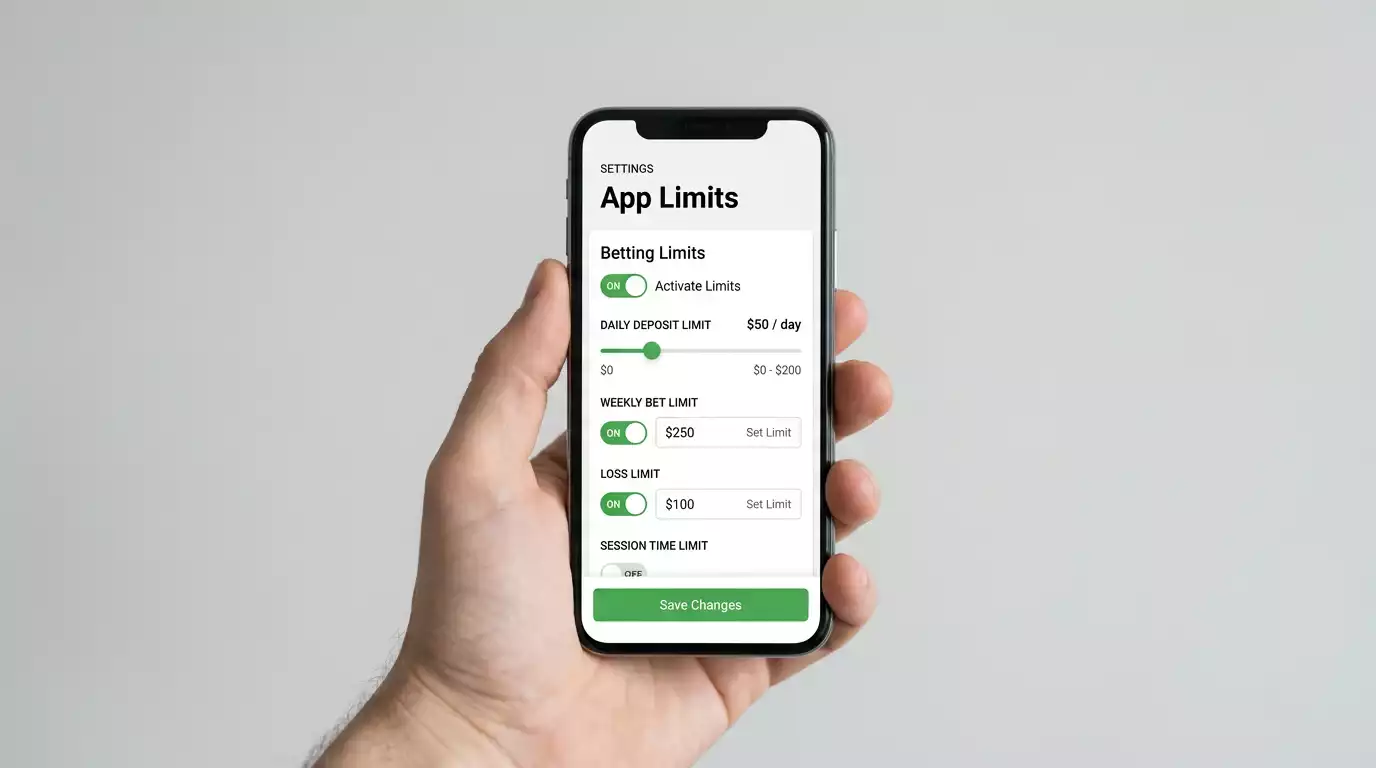
From October 2025, all UKGC-licensed bookmakers must offer customers the option to set financial limits before making their first deposit. This is not voluntary — it is a regulatory requirement that applies to every operator serving UK bettors, including those offering NFL prop markets.
The regulatory changes enacted in 2025 and scheduled for 2026 have direct implications for NFL bettors. Since April 2025, maximum stakes on online slots have been capped at £5 for bettors aged 25 and over, and £2 for those aged 18-24. While this does not directly apply to sports betting, it reflects the Commission's direction of travel toward tighter controls across all verticals. More directly relevant: the Remote Betting Duty for online operators will increase from 21% to 40% in April 2026 — a near-doubling that operators will almost certainly absorb partly through adjusted margins, potentially affecting the odds available on NFL prop markets.
The unlicensed gambling market in Britain has grown to an estimated £16.6 billion, roughly tripling since 2019. The share of the legal market has declined from 97% to 92% in the same period. For NFL bettors, this underscores a practical point: always verify your bookmaker's UKGC licence before depositing funds. Unlicensed operators offer no recourse if disputes arise and no guarantee that your funds are protected.
I will not pretend that regulation makes betting safer by default — it makes it safer if you operate within the regulated framework. That means UKGC-licensed operators only, verified deposit limits, and awareness of the protections available to you. The detailed step-by-step process for checking a bookmaker's licence status and navigating the 2025-2026 regulatory changes is covered in the guide to choosing the best NFL betting site in the UK.
Responsible Betting: Tools and Limits Every Punter Should Use
I have watched sharp, disciplined analysts blow through a season's bankroll in two bad weeks because they had no guardrails. It was not a lack of knowledge — it was a lack of structure. The tools exist to prevent that, and they are built into every UKGC-licensed platform you will use for NFL props. Using them is not a sign of weakness; it is the operational equivalent of wearing a seatbelt. You do not skip it because you are a good driver.
Since October 2025, every UK bookmaker must prompt customers to set financial limits before their first deposit. That regulatory push did not appear from nowhere. The AGA's Bill Miller has emphasised that the legal, regulated industry invests heavily in responsible gaming initiatives — tools like deposit limits, time limits, and exclusion options are standard offerings by licensed operators, designed to ensure that participation remains a positive experience. Those words apply to NFL prop bettors as directly as they do to anyone else.
Responsible betting tools to activate before your first NFL prop bet
- Deposit limit: Set a weekly or monthly ceiling on how much money you can add to your account. Once reached, no further deposits are possible until the period resets.
- Loss limit: Cap the total amount you can lose in a defined period. Distinct from deposit limits — this tracks net losses, not just deposits.
- Time limit: Set session duration alerts or hard cutoffs. NFL Sundays can run from 18:00 to past midnight UK time — time limits prevent a single bad result in the early window from triggering impulsive bets in the late games.
- Reality check: Periodic pop-up notifications that display your session duration and net position. Most UK apps offer these at 30-minute or one-hour intervals.
- Self-exclusion: If you need a break, GAMSTOP provides a single registration that blocks you from all UKGC-licensed online gambling sites for a minimum of six months.
NFL prop betting in the UK benefits from a uniquely structured schedule: games kick off in defined windows (18:00, 21:00, 01:20 GMT on Sundays, plus Thursday and Monday night games). Use that structure to set pre-defined betting windows. Decide before kickoff which games and markets you will bet, confirm your selections, and then close the app. The schedule does the work of a time limit if you let it.
I track every prop bet I place in a spreadsheet — not just the result, but the reasoning, the odds at placement, and whether I followed my own process. Over time, that record becomes a mirror. It shows you when you are betting with discipline and when you are drifting into reactive, emotion-driven decisions. The bets where I skipped my checklist — where I jumped on a line at halftime because the first half went against me — are overwhelmingly the ones that lost. The data does not lie, even when it is your own data reflecting your own mistakes.
Frequently Asked Questions About NFL Player Betting in the UK
What are NFL player prop bets and how do they work?
Player prop bets are wagers on an individual player's statistical performance during a game, completely separate from the match result. You choose a player, a statistical category (passing yards, rushing yards, receptions, touchdowns), and then bet on whether the actual outcome will be over or under a line set by the bookmaker. For example, if a quarterback's passing yards line is set at 269.5, you bet over if you believe he will throw for 270 or more yards, or under if you expect 269 or fewer. Payouts are determined by the odds attached to each side of the line, typically displayed in decimal format on UK bookmaker apps.
Is NFL player betting legal in the UK?
Yes. NFL player prop betting is fully legal in the UK when conducted through a bookmaker holding a licence from the UK Gambling Commission. The Gambling Act 2005 permits betting on any sport through licensed operators, and NFL markets — including all player prop categories — fall within that framework. The critical requirement is that your chosen bookmaker is UKGC-licensed, which you can verify on the Gambling Commission's public register. Unlicensed operators exist and should be avoided entirely, as they offer no regulatory protections for your funds or your disputes.
What types of NFL player props can I bet on?
The five main categories are passing props (yards, touchdowns, completions, interceptions), rushing props (yards, carries), receiving props (yards, receptions, targets), defensive props (sacks, interceptions, tackles), and touchdown scorer props (anytime, first, last). Within those categories, UK bookmakers increasingly offer niche lines such as longest completion, longest rush, and combo props like passing plus rushing yards. The depth of available markets varies by operator and by the profile of the game — primetime fixtures and playoff games typically generate more prop options than early-season matchups between lower-profile teams.
How do I read NFL player prop odds in decimal and fractional format?
Decimal odds show your total return per unit staked. Odds of 1.91 mean a £10 bet returns £19.10 (including your original stake), giving a profit of £9.10. Fractional odds show profit relative to stake: 10/11 means £10 profit for every £11 staked, returning £21 total. Most UK bookmaker apps default to decimal for NFL markets, but you can switch to fractional in your account settings. To convert decimal to fractional, subtract 1 from the decimal odds and express the result as a fraction — 1.91 becomes approximately 10/11. The key is consistency: pick one format, learn it deeply, and use it for all your line comparisons.
Which positions generate the most prop markets each week?
Quarterbacks generate the deepest prop menus because they touch the ball on every passing play and produce the most trackable statistics. A starting quarterback will typically have lines for passing yards, passing touchdowns, completions, attempts, interceptions, and longest completion. Running backs come next with rushing yards, carries, and rushing touchdowns, followed by wide receivers and tight ends with receiving yards, receptions, and targets. Defensive player props — sacks, interceptions, tackles — are available but often limited to high-profile players or primetime games. Kicker props (field goals made, total points) round out the list on platforms that offer full-depth NFL coverage.
How does weather affect NFL player props?
Weather is one of the most underpriced variables in NFL prop betting. Wind speeds above 15 mph measurably reduce passing accuracy and distance, making passing yards unders more attractive. Heavy rain increases fumble risk and suppresses both passing and receiving volumes, while extreme cold can affect ball handling across all skill positions. Dome games eliminate weather as a variable entirely, which tends to stabilise prop lines closer to season averages. I always check game-day forecasts for outdoor venues as part of my pre-bet routine — a clear forecast at the time lines are posted can shift dramatically by kickoff, and the line may not have moved to reflect it.
What is a same game parlay for NFL player props?
A same game parlay — also called a bet builder on most UK platforms — allows you to combine multiple selections from a single game into one bet. For player props, that might mean pairing a quarterback's passing yards over with a wide receiver's receptions over and an anytime touchdown scorer. All legs must win for the bet to pay out, and the combined odds are typically lower than a simple multiplication of individual odds because bookmakers apply a correlation adjustment — if the quarterback throws for a lot of yards, it is also more likely that his primary receiver catches more passes. Understanding that correlation pricing is essential to evaluating whether an SGP offers genuine value or just the illusion of a big payout.
Articles
Written by the editors at NFL Player Betting.
